
Last verified against the Electrical Safety Authority Bulletins 64-7-2 and 64-8-2, Home Renovation Savings program rules, Ontario Energy Board prices for November 1, 2025 to October 31, 2026, and manufacturer datasheets.
The difference between a low voltage and a high voltage solar battery is how it connects to the inverter: a 48 volt bank versus a link at a few hundred volts DC. High voltage systems such as Tesla, Fox ESS and Sigenergy are usually the better choice for a grid tied Canadian home. Low voltage wins on price per kWh.
Solar Calculator Canada is an independent Canadian platform that provides free solar and battery estimates and matches homeowners with vetted installers. We do not install and we do not sell batteries. Every claim below comes from manufacturer documents or Canadian regulators, with the source named.
Get your free solar and battery estimate
What Is the Difference Between a Low Voltage and a High Voltage Solar Battery?
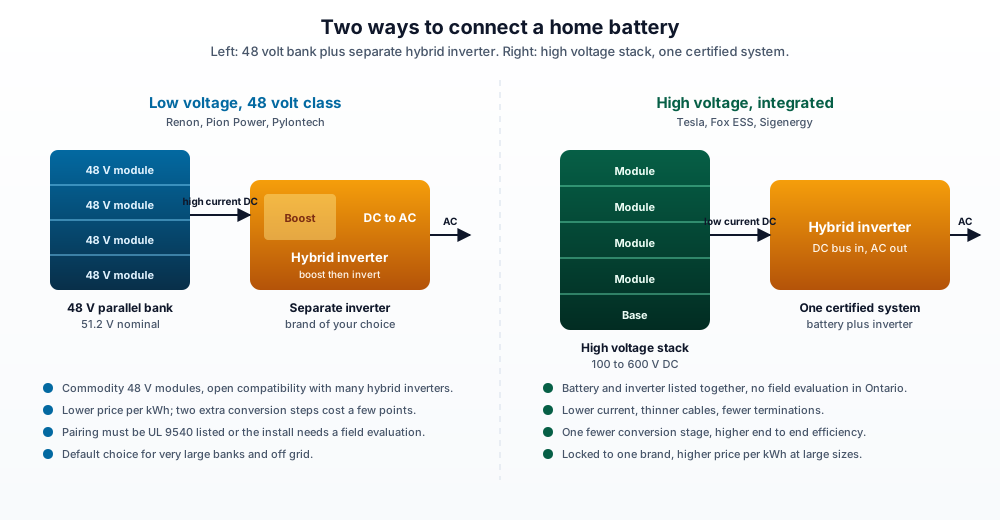
A low voltage solar battery is a 48 volt class bank, usually 51.2 volts nominal, that plugs into the low voltage battery port of a hybrid inverter. A high voltage solar battery exchanges power with the inverter at roughly 100 to 600 volts DC, and is normally sold together with its own inverter or controller as one certified system.
One detail the marketing skips: under the Canadian Electrical Code, "low voltage" runs from 31 to 750 volts and "high voltage" only starts above 750 volts, according to SkilledTradesBC's electrical code training material. Every home battery in this guide is low voltage equipment by that definition. The labels describe the wiring architecture, not the code class.
Usable capacity is the energy you can actually draw, which is less than the nominal kWh on the box. Continuous power, in kW, is set by the inverter, not by the battery's voltage.
Which Brands Are High Voltage and Which Are Low Voltage?
The brands on Canadian quotes split mostly, but not perfectly, along this line. Here is what each manufacturer publishes for its North American products as of September 2026.
| Product | Class | What the manufacturer publishes | Pairing and certification |
|---|---|---|---|
| Tesla Powerwall 3 | High voltage, integrated | 13.5 kWh per unit, 11.5 kW continuous, up to 20 kW of solar DC input, 89 percent solar to battery to home. Internal pack voltage not published | Built in inverter; listed as a system with Tesla gateway hardware |
| Fox ESS ECS4000 with H1 inverter | High voltage stack | 3.975 kWh modules of 57.6 volts wired in series, up to 5 per stack (19.88 kWh), 90 percent depth of discharge | Fox ESS H1 hybrid inverter, 5.7 to 11.4 kW; sold as a UL 9540 listed kit |
| Sigenergy SigenStor BAT 6.0 and 9.0 | High voltage stack | 6.02 and 9.04 kWh modules, each with a built in optimizer feeding a 300 to 600 volt bus; modules can be mixed | Sigen Energy Controller up to 11.5 kW; listed as a system |
| Renon Xcellent Plus and Xtreme LV | Low voltage | 48 volt class, 16 kWh per Xcellent Plus unit, expanded in parallel | UL 9540 listed as a system with Sol-Ark 12K and 15K inverters |
| Pion Power 13.5 kWh | Low voltage | 13.5 kWh lithium iron phosphate unit, stackable up to 8, IP65, sold with 48 volt class hybrid inverters; publishes cell and pack level certifications | Ask for the system level listing for the inverter pairing quoted |
| Pylontech US5000 | Low voltage | 48 volt nominal, 4.8 kWh per module, 4.56 kWh usable, expanded in parallel | Published list of third party 48 volt hybrid inverters |
Sources: manufacturer datasheets, product pages and distributor documentation, September 2026. URLs are in the Sources section. Figures are manufacturer claims, not independent test results.
Two facts complicate the neat split. Renon also sells the Xtreme HV 1.0, a 192 to 384 volt stack that is UL 9540 listed with Fronius GEN24 Plus inverters, so Renon is a brand with both lines. And Sigenergy's own datasheet describes its modules as low voltage cells boosted to a high voltage bus by an optimizer in each module. The practical distinction is between an integrated, single vendor system and an open, 48 volt system assembled from parts.
Why Is High Voltage Usually the Better Choice?
Lower current for the same power. Power is voltage multiplied by current. Delivering 5 kW at 48 volts takes about 104 amps; at 400 volts it takes about 12.5 amps. Lower current means thinner conductors, smaller fuses and less energy lost as heat in cables and terminations.
One fewer conversion stage. A 48 volt hybrid inverter boosts the battery up to its internal bus before making AC, then steps it back down to charge. A high voltage battery already sits near that bus. Tesla's 89 percent solar to battery to home figure is an end to end number. Many 48 volt batteries publish 95 percent or better, but that is the battery alone, before inverter losses, so the two figures are not comparable.
Certified as one system. This is the point that matters most in Canada, and it has nothing to do with volts. Tesla, Fox ESS and Sigenergy arrive with battery, power electronics and controls certified together. As the safety section explains, that avoids a field evaluation in Ontario.
Cleaner installs and one warranty. Stackable, plug together modules mean less field wiring and fewer terminations that can loosen. One vendor covers battery, inverter, app and warranty, so no one argues later about which company owns a fault.
What Are the Pros and Cons of a Low Voltage Battery?
Pro: price per kilowatt hour. A 48 volt lithium iron phosphate module is a commodity made by many factories, so low voltage banks are often the cheapest way to buy a lot of storage.
Pro: open compatibility. Pylontech, for example, publishes a compatibility list covering many third party hybrid inverters, so a 48 volt bank can often be reused if the inverter brand disappears. High voltage stacks are locked to their own brand's inverter, and even within a brand, module generations may not mix.
Pro: expansion, service and off grid use. Adding capacity means bolting on another parallel unit, and a failed module is simpler to swap. Most off grid inverters were built around 48 volt banks. Lower voltage reduces shock severity during service, although both classes need a licensed electrician for DC work.
Con: certification depends on the pairing. A 48 volt battery from one company and an inverter from another is only as simple as its certification. Some pairings are listed together, like Renon with Sol-Ark. Others are not, and then the installation needs a field evaluation before it can be connected.
Con: more current, more parts. Higher current means heavier cables, larger fuses and more field terminations, each a place for an installation error to hide. The extra boost stage also costs a few points of efficiency.
Pros and Cons Side by Side
| Criterion | High voltage (Tesla, Fox ESS, Sigenergy) | Low voltage (Renon, Pion Power, Pylontech) |
|---|---|---|
| Efficiency end to end | Higher; one fewer conversion stage | Slightly lower; battery boosted to the inverter bus |
| Current and cabling | Low current, thin cables, fewer terminations | High current, heavy cables, more terminations |
| Approval path in Ontario | Listed as one system; no field evaluation | Field evaluation unless the exact pairing is listed |
| Price per kWh | Higher; inverter and controls included | Lower; commodity modules |
| Inverter flexibility | Locked to one brand | Works with many brands on the compatibility list |
| Expansion | Within module count limits of the inverter | Parallel units, often a dozen or more |
| Best capacity range | 10 to 20 kWh | 15 kWh to 40 kWh and beyond |
| Off grid | Rarely the default | The default |
| Service | Manufacturer trained network | Any qualified electrician with the inverter's support |
How Do Canadian Safety Rules Treat Each Type?
The rules barely mention voltage class. They care whether the whole system is approved as a system, where it sits, and how much energy is in one place. Ontario is the example here; other provinces adopt the Canadian Electrical Code on their own schedules.
According to the Electrical Safety Authority's Bulletin 64-7-2, every energy storage system used or sold in Ontario must be approved, either by certification to ANSI/CAN/UL 9540 or by a field evaluation, with narrow exceptions for lead acid and very small systems. When separate equipment is combined into a system, ESA treats it as a complex installation that needs that field evaluation. That is the single biggest practical advantage of an integrated high voltage system, and the single biggest question to ask about any 48 volt quote.
ESA's Bulletin 64-8-2, issued May 2024, sets the residential placement rules, and they apply equally to both types.
| Rule area (Ontario, May 2024 bulletin) | What it says |
|---|---|
| Residential use limit | No more than 20 kWh in any single energy storage unit |
| Attached garage or exterior wall | Aggregate capacity up to 80 kWh |
| Dedicated or utility room indoors | 20 kWh per system, 40 kWh aggregate, self closing door, gypsum board walls and ceiling |
| Location | Never in a sleeping area or a room opening directly into one |
| Separation | At least 1 m from any window or door other than a vehicle door, and 1 m between systems unless certified instructions allow less |
| Detection | A smoke alarm in the room where an indoor system is installed |
Source: Electrical Safety Authority, Bulletin 64-8-2, May 2024. See our guide to Ontario home battery placement rules for the four code approved locations.
Does the Choice Change Your Rebate or Your Savings?
For rebates, no. Ontario's Home Renovation Savings program pays $300 per kWh of battery storage up to $5,000, capped at 50 percent of cost, as of September 2026, according to the program's solar and storage page. The battery must be paired with a new solar system, sized to it, and installed only after written pre approval. Voltage class is not mentioned.
The trap is net metering. The same page states that homeowners who take the rebate are not eligible for a net metering agreement with their utility. The rebate is for load displacement only, where the solar and battery serve the home's own consumption. Our net metering guide explains the difference, and our incentives page tracks battery programs in other provinces as they change.
For bill savings, the efficiency gap is real but small in dollars. Suppose two systems each shift 10 kWh a day from overnight to the evening peak on Ontario's Ultra Low Overnight plan. System A delivers 89 percent end to end, Tesla's published Powerwall 3 figure. System B, a hypothetical 48 volt setup, delivers 85 percent. The gap is 0.4 kWh a day. At the ULO on peak price of 39.1 cents per kWh, set by the Ontario Energy Board for November 1, 2025 to October 31, 2026, that is about 16 cents a day, or roughly $40 a year over 260 weekdays. Rates change every November and your usage will differ, so treat this as an estimate. Price, usable capacity, certification and warranty terms move payback far more than a spec sheet decimal.
See what a battery could save on your bill
What Does Each Type Cost in Canada?
Installed home battery pricing in Canada commonly lands between roughly $500 and $1,600 per kWh of nominal capacity before rebates, as a September 2026 estimate derived from the prices and capacities on our best solar batteries guide. Low voltage banks sit near the bottom; integrated high voltage systems sit near the top because the inverter and controls are in the price. Installer quotes govern; these are estimates, not offers.
What moves the price on either type: usable rather than nominal kWh, the inverter's continuous rating, whole home backup hardware, indoor room work to meet placement rules, and heated modules for cold garages. The calculator on this site estimates production, bill impact and payback from your address, roof and usage. It does not pick a brand and it is not a quote.
Low Voltage vs High Voltage Solar Battery: Which Should You Choose?
| Your situation | Usual fit | Why |
|---|---|---|
| New solar plus 10 to 20 kWh on a grid tied home | High voltage | One certified system, fewer conversion stages, simplest approvals |
| Whole home backup for a heat pump or EV charger | High voltage, or a listed 48 volt pairing | Continuous output rating and a listed inverter pairing matter more than voltage class |
| 30 kWh or more for a rural or outage prone property | Low voltage | Lowest cost per kWh at scale, subject to placement caps and certification |
| Existing 48 volt hybrid inverter already installed | Low voltage | Reuse what you own if the pairing is approved |
| Off grid | Low voltage | Most off grid inverters are built for 48 volt banks |
| Want freedom to switch inverter brands later | Low voltage | Open compatibility |
If you are on a flat rate plan with no time of use spread, rarely lose power, or use very little electricity, a battery may not pay back inside its warranty on either architecture. Solar alone may be the better first step, and the estimate will show you.
What to Ask Before You Sign
- Is the exact battery and inverter combination on the quote certified to ANSI/CAN/UL 9540 as a system, or will it need a field evaluation? Ask for the certificate.
- What is the usable capacity in kWh, and what depth of discharge does the warranty assume?
- Can I add capacity later on the same inverter, with future module compatibility confirmed in writing?
- Does the rebate path I am choosing block net metering, and is that the path I want?
The Bottom Line on Low vs High Voltage Batteries in Canada
The low voltage vs high voltage solar battery decision comes down to integration. High voltage systems from Tesla, Fox ESS and Sigenergy bundle battery, inverter and controls into one certified product, which gives them lower current, better end to end efficiency and the simplest approval path in Canada. That is why they are the better choice for most grid tied homes adding solar and a modest battery. Low voltage systems from Renon, Pion Power, Pylontech and others cost less per kWh and work with many inverters, which suits very large, off grid or open ecosystem projects, provided the pairing is certified.
Get your free solar and battery estimate
Frequently Asked Questions
Common questions readers ask about this topic
The connection to the inverter. A low voltage battery is a 48 volt class bank that plugs into a hybrid inverter's low voltage port. A high voltage battery links at roughly 100 to 600 volts DC and is normally sold with its own inverter as one certified system. That integration, more than the voltage itself, drives the differences in efficiency, cost and approvals.
Neither is inherently safer for a homeowner. Current products in both classes use lithium iron phosphate cells, both are low voltage equipment under the Canadian Electrical Code, and both must be approved as a complete system. Lower current in a high voltage system reduces heat in cables; lower voltage in a 48 volt system reduces shock severity during service. Safety comes from certification, placement and a licensed installer.
Tesla does not publish the internal pack voltage, so the label cannot be confirmed from the datasheet. It belongs in the high voltage group in practice because the battery and solar inverter are built into one sealed, certified unit with a DC bus that accepts up to 20 kW of solar. For a buyer, that integration is what matters, not the number of volts inside.
Per kilowatt hour, low voltage is usually cheaper because 48 volt modules are commodity products and the inverter is bought separately. High voltage systems include the inverter, controls and software in the price. As a September 2026 estimate, installed pricing in Canada runs from roughly $500 per kWh at the low voltage end to about $1,600 per kWh for integrated systems, before rebates.
No. A 48 volt battery cannot connect to a high voltage battery port, and the reverse is also true. Batteries and inverters must match in voltage class and communication protocol, and in Ontario the exact combination must be certified as a system or pass a field evaluation. Always ask for the certificate for the specific pairing on your quote.
Editorial note: ESA bulletins, HRS program rules, OEB prices and manufacturer datasheets on this page are set by the Electrical Safety Authority, the administrators of the Home Renovation Savings program, the Ontario Energy Board, and each manufacturer. Rules and prices are revised periodically. Confirm current terms with each source before making a purchase decision.
Sources
- Electrical Safety Authority, Bulletin 64-7-2, Installation and Approval of Energy Storage Systems (PDF).
- Electrical Safety Authority, Bulletin 64-8-2, Battery based energy storage systems at residential occupancies, May 2024 (PDF).
- Home Renovation Savings (Save on Energy and Enbridge Gas), Solar panels and battery storage rebates.
- Ontario Energy Board, News release announcing prices effective November 1, 2025.
- Tesla, Powerwall 3 Datasheet, North America (PDF).
- Sigenergy, SigenStor product page.
- Sigenergy, SigenStor battery datasheet, module voltage range, cell capacity and stack limits (PDF).
- Solar Electric Supply, SigenStor BAT 9.0 US listing with published capacity, power and certification.
- Fox ESS, Battery product range.
- Piercing Star Energy, Fox ESS ECS4000 North American module specification and certification listing.
- Renon Power, Xtreme LV product page.
- Renon Power, Xtreme HV 1.0 product page.
- Renon Power, Fronius and Renon high voltage pairing announcement, January 2026.
- Solar Power World, Renon batteries reach UL 9540 certification with Sol-Ark inverters, August 2025.
- Pion Power, 13.5 kWh battery for home and small business.
- Pylontech, US5000 product page.
- SkilledTradesBC, Canadian Electrical Code voltage definitions, open textbook.
- Solar Calculator Canada, Best Solar Batteries Canada 2026.